

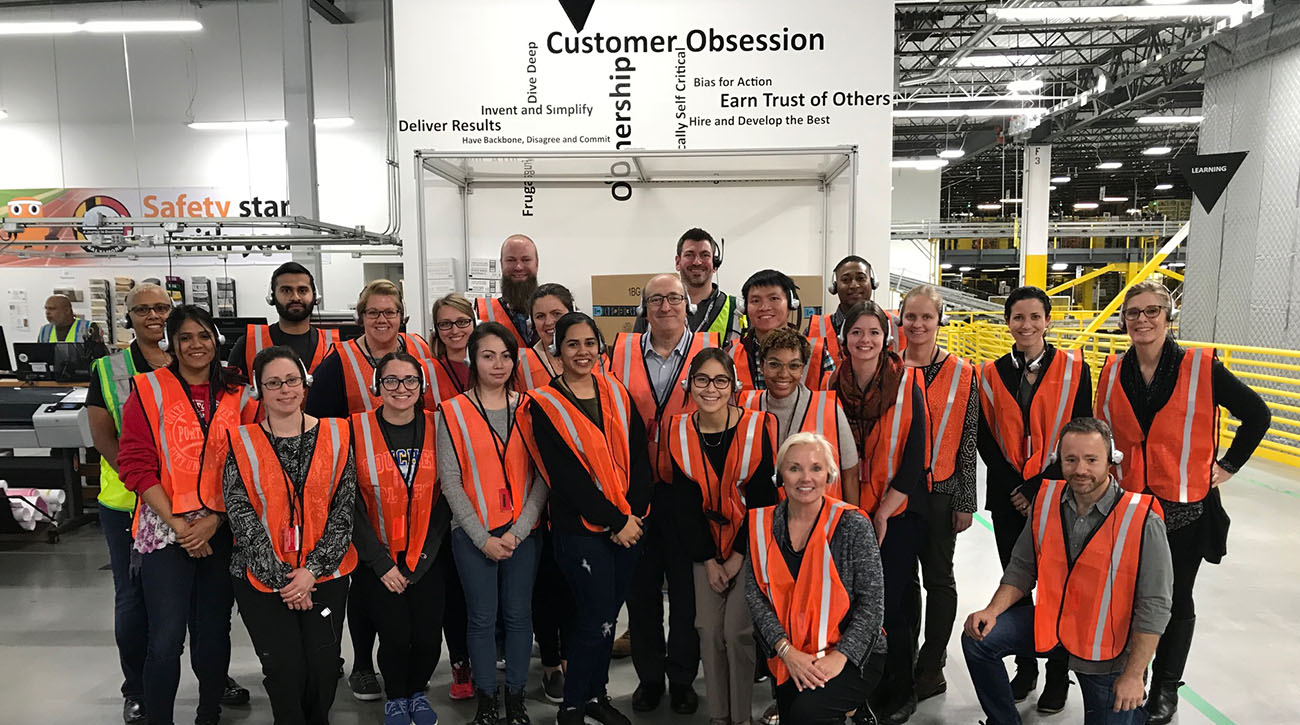
As the former head of the Occupational Safety and Health Administration (OSHA), David Michaels, PhD often receives invitations from leaders of businesses large and small who want to hear his unbiased observations about their safety practices. When Amazon.com’s Vice President of Health, Safety, Sustainability, Security and Compliance, Carletta Ooton, offered to take Michaels on a tour of one of the corporate giant’s gargantuan fulfillment centers, he readily accepted. Michaels’ only stipulation was that he bring along a group of students, alumni, faculty and staff from the George Washington University (GW) Milken Institute School of Public Health’s Department of Environmental and Occupational Health (EOH).
In addition to agreeing to host up to 20 EOH visitors, Amazon arranged for a bus to transport everyone--including Ooton--from Washington, D.C., to the company’s “BWI2” facility in Baltimore. As soon as students learned about the opportunity, the available spots were gone in a matter of days.
Both Ooton and Paul Pace, Amazon’s Environmental Health and Safety Worldwide director, flew to Washington from Amazon’s headquarters in Seattle so that they could maximize their time with Michaels and the GW group. During the trip to Baltimore, Ooton and Pace briefed the group about the three-year-old BWI2 facility.
The ability to process one million items a day
Amazon’s fulfillment centers are vast warehouses chock-full of the products that the company expects its customers to purchase, plus equipment to retrieve and package up goods once an order is placed. The one-million-square-foot BW12 fulfillment center has 3000 employees and has the capacity to process more than one million items a day. The use of robots and automated equipment to do the heavy lifting and moving of Amazon goods while enhancing safety now in place at BWI2 is being phased in throughout the company’s 100-plus fulfillment operations around the U.S. While the increased embrace of automation has reduced the chance for injuries, the BWI2 facility, like all fulfillment centers, conducts audits of the most at-risk areas for serious injuries or potential deaths each week, Pace said.
Mike Stone, the director of Amazon’s North American Customer Fulfillment Environmental Health and Safety, led the BWI2 tour. It began with the whiteboards prominently displayed near the building entrance where employees are encouraged to share information about any issues and concerns they may have. Amazon.com has an anti-retaliation policy protecting employees who raise awareness about safety concerns, Ooton stated.
As Stone led the visitors along the colossal facility’s “green mile” path designated to ensure that workers and visitors stay out of harm’s way, he made frequent stops. He collaborated with the center’s employees to show how workers facilitate the largely automated and robot-mediated transit of goods through the immense facility. Humans, robots and other machinery collaborate on each step, beginning with storing each purchasable item that comes into the fulfillment facility. Safety features include “light curtains” that automatically shut down equipment that stacks containers on pallets if an unauthorized person enters.
Oversize Roombas topped with Ikea shelving
Robots and automated equipment also play important roles in retrieving items ordered by Amazon customers, as well as aiding in the process of packaging up orders before they are whisked out of the building toward their ultimate destinations. The facility employees who spoke about their jobs included a robotics mechanic en route to evaluate one of the facility’s thousands of Kiva robots, which a recent Wall Street Journal article about the BWI2 facility characterized as resembling oversize Roombas topped with Ikea shelving.
Highlights included learning about how new Amazon employee are trained. Training involves learning how to use the equipment in a realistic setting and educating employees regarding issues to consider and scan for to help reduce the risk of things going awry. It also includes learning how to do stretching exercises aimed at strengthening and protecting workers’ bodies for the tasks they perform in their assigned stations—exercises that employees and managers alike do every day at the start of their shifts. “Both temporary and permanent workers receive the same training,” Ooton stressed.
Evolving and improving efforts to track and respond to safety concerns
After the tour, Ooton, Pace and Stone—as well as the eight other Amazon executives from throughout the country who were on hand for the tour—told the GW group about Amazon’s continually evolving and improving efforts to track and respond to safety concerns. Current projects underway include adding telemetry features to enhance safety for the power industrial trucks used to transport heavy pallets filled with goods. The telemetry controls access and limits speeds. The Amazon executives also shared details about new initiatives and pilot projects that are underway, but too early to discuss publicly.
At the end of the day, Michaels said that he was favorably impressed by what he learned about Amazon’s use of automated equipment, in combination with the approach to tracking issues on display during the tour. Some of the EOH students and alumni also expressed interest in learning about employment opportunities at Amazon.